Astronomers have recently identified seven additional instances of a celestial occurrence termed "dark comets," which may provide insights into whether these enigmatic objects played a role in transporting essential elements such as water to Earth during its early formation. This discovery has doubled the previously known count of these obscure celestial entities within our solar system, which, while resembling asteroids, exhibit comet-like trajectories through space, albeit without the characteristic "tail" associated with comets.
The new findings, detailed in a study published on December 9th in the Proceedings of the National Academy of Sciences, also reveal the existence of two distinct groups among these objects. The increased knowledge of dark comets has led astronomers to conclude that they are not as uncommon as initially thought. "Studying small celestial bodies, such as asteroids and comets, is crucial as they offer clues about the distribution of materials across the solar system," explained Darryl Seligman, the lead researcher and a postdoctoral fellow in physics and astronomy at Michigan State University, East Lansing, in a press release. "Dark comets represent a novel category of near-Earth objects that might harbor water, thus serving as a potential conduit for delivering vital materials to Earth that were instrumental in the emergence of life. The more we uncover about these objects, the clearer our understanding of their part in our planet's genesis becomes."
In the past, astronomers examining an asteroid known as 2003 RM noticed a slight deviation from its anticipated path. This deviation could not be accounted for by the typical accelerations experienced by asteroids, such as the Yarkovsky effect, which involves space rocks absorbing solar heat and then emitting it as infrared radiation, resulting in a slight thrust for the asteroid. Instead, 2003 RM's movement was more comet-like. The sun induces the sublimation process in comets, where ice within them directly turns into gas, providing the thrust that creates the tail visible behind comets. "Despite our efforts, we found no evidence of a comet's tail. The object appeared as a mere point of light, akin to any other asteroid. For a time, we had this peculiar celestial entity that we couldn't fully comprehend," said Davide Farnocchia, a navigation engineer at NASA's Jet Propulsion Laboratory in Pasadena, California, in a statement. "This poses a puzzle that challenges our traditional classification of celestial objects as either asteroids or comets."
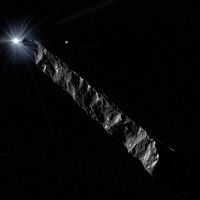
The discovery of 'Oumuamua in 2017 marked the first observed object within our solar system that originated beyond it. Scientists had a brief opportunity to observe 'Oumuamua with telescopes before it swiftly traversed our solar system, sparking numerous theories about its true nature, including speculation that it might have been an extraterrestrial probe. Telescope observations indicated that 'Oumuamua appeared as a solitary point of light, much like an asteroid, but its trajectory suggested material shedding, similar to a comet, complicating the determination of its classification. "‘Oumuamua was surprising in several respects," Farnocchia remarked. "The fact that the first object we discovered from interstellar space displayed behaviors akin to 2003 RM made 2003 RM even more intriguing."
In 2023, Farnocchia and Seligman each published research describing a total of seven objects within our solar system with peculiar characteristics akin to 'Oumuamua, blurring the line between asteroids and comets. These scientists have since termed this new category of celestial objects as dark comets. With the discovery of seven additional dark comets, researchers have been able to discern differences between their populations. "With a sufficient number of dark comets, we could begin to explore whether there were any distinguishing features among them," Seligman stated. "By analyzing their reflectivity and orbits, we discovered that our solar system contains two distinct types of dark comets."
Inner dark comets, found within the inner solar system that includes Earth, Venus, Mars, and Mercury, orbit the sun in nearly circular paths and are relatively small, reaching only tens of meters in diameter. They may have originated from the main asteroid belt, situated between the orbits of Mars and Jupiter. In contrast, outer dark comets, potentially hailing from the outer regions of our solar system near and beyond Jupiter, have distinctly elliptical orbits and can extend to hundreds of meters or more in size.
With the identification of dark comet populations, astronomers are now keen to determine whether these objects contain ice, the cause of their acceleration, and their origins. Gaining a deeper understanding of dark comets could illuminate whether these celestial bodies contributed to Earth's early evolution by impacting the planet during its formation. "What many may not consider regularly is that the solar system is a chaotic environment," Seligman said. "We are uncertain about the origins of various objects, but with the 14 dark comets now known to be orbiting within our solar system, there are opportunities in the coming years to gather more data and hopefully uncover answers about the formation of our own planet."
Previous studies have suggested that up to 60% of near-Earth objects could be dark comets. While asteroids, due to their closer orbits to the sun, are devoid of ice, comets are icy bodies that resemble dirty ice cubes with more distant orbits, according to Aster Taylor, a coauthor of the new study and lead author of a study published online in the journal Icarus in July about dark comets. Taylor is a doctoral student in astronomy at the University of Michigan. However, dark comets that are near-Earth objects could be located in the main asteroid belt, between the orbits of Mars and Jupiter, and may contain ice. If ice is prevalent on small bodies like dark comets in the near-Earth environment, they may have been responsible for delivering water to Earth.
Astronomers are also endeavoring to understand why dark comets are so small and rotate so rapidly, Taylor noted. "It's quite plausible that the activity on the inner main belt objects was triggered by some form of physical alteration, such as the destruction of the object, which is suggested by the small sizes and rapid rotation rates of the inner dark comets," Taylor said. "However, these are all hypotheses, and while they align with all of our data, further research is needed to confirm or refute these ideas."
Fortunately, the Japan Aerospace Exploration Agency's Hayabusa2 spacecraft is anticipated to encounter one of the dark comets, 1998 KY26, in 2031 as part of its extended mission, which could reveal more of the unique traits of these not-so-rare celestial entities, Taylor mentioned.

By Laura Wilson/Dec 21, 2024

By Victoria Gonzalez/Dec 21, 2024

By James Moore/Dec 21, 2024

By Laura Wilson/Dec 21, 2024

By Lily Simpson/Dec 21, 2024

By Noah Bell/Dec 21, 2024
By Thomas Roberts/Dec 21, 2024

By Samuel Cooper/Dec 21, 2024
U6FGL)1L%5DUR%7B%7D~%24GQ7.png)
By Noah Bell/Dec 21, 2024

By Elizabeth Taylor/Dec 21, 2024

By Ryan Martin/Oct 15, 2024

By Eric Ward/Oct 15, 2024

By Joshua Howard/Oct 15, 2024

By Victoria Gonzalez/Oct 15, 2024

By Sophia Lewis/Oct 15, 2024

By Lily Simpson/Oct 15, 2024

By Ryan Martin/Oct 15, 2024

By Ryan Martin/Oct 15, 2024

By Jessica Lee/Oct 15, 2024