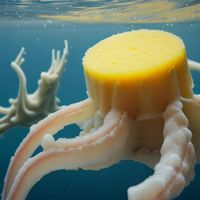
Microplastic contamination is pervasive, reaching the highest points of Mount Everest and the depths of the ocean's trenches. These minuscule plastic fragments are present in bottled water, within human placentas, and even in breast milk. They pose a threat to wildlife, disrupt natural ecosystems, and have the potential to harm human health. Their removal is a significant challenge, but researchers in China have developed a promising solution: a biodegradable sponge crafted from squid shells and cotton fibers.
A team from Wuhan University utilized chitin extracted from squid shells and cellulose from cotton, both of which are organic compounds recognized for their ability to mitigate pollution in wastewater, to fabricate this eco-friendly sponge. The sponge's effectiveness was tested across four distinct water sources, including irrigation, pond, lake, and sea water, with results indicating it could remove up to 99.9% of microplastics, as detailed in a study published in Science Advances. The researchers emphasized the urgent threat microplastics pose to our planet, particularly to aquatic ecosystems, stating, "Even with various measures such as plastic reduction, waste management, and environmental recycling, the pollution caused by microplastics is irreversible and continues to worsen."
Microplastics, defined as plastic particles smaller than 5 millimeters, originate from a variety of sources, including tires that break down into smaller pieces and microbeads found in cosmetic products like exfoliants. A 2020 study estimated that there are approximately 14 million metric tons of microplastics on the ocean floor. Scientists have identified microplastics as one of the critical environmental challenges of our time, with the issue gaining international recognition. Plastic pollution is persistent, harming wildlife, the oceans, and raising concerns about potential health risks to humans. The situation is expected to deteriorate, with plastic production and pollution on the rise in the coming years. Even with immediate and global efforts to reduce plastic consumption, it is estimated that by 2040, approximately 710 million metric tons of plastic will continue to pollute the environment. This urgency underscores the need for solutions to eliminate plastic contamination in our oceans.
The sponge developed by the Wuhan researchers was capable of absorbing microplastics through both physical interception and electromagnetic attraction, as reported in the study. Traditional methods for plastic absorption are often costly and complex to produce, limiting their potential for large-scale application. In contrast, last year, researchers in Qingdao, China, created a synthetic sponge from starch and gelatin designed to remove microplastics from water, with varying effectiveness depending on water conditions. The low cost and widespread availability of cotton and squid shells suggest that the Wuhan-developed sponge has significant potential for extracting microplastics from various water bodies, as indicated in the study.
Shima Ziajahromi, a lecturer at Australia's Griffith University specializing in microplastics, described the squid-cotton-sponge method as "promising" and a potentially effective approach to "clean up high-risk and vulnerable aquatic ecosystems." However, Ziajahromi, who was not part of the study, noted that the study's authors did not address the sponge's ability to remove microplastics that settle in sediments, which constitute the majority of microplastics in our waters. Another critical issue, according to Ziajahromi, is the proper disposal of the sponges. "Although the material is biodegradable, the microplastics it absorbs need to be disposed of correctly," she said. "Without careful management, this process could inadvertently transfer microplastics from one ecosystem to another." Ziajahromi concluded that minimizing plastic pollution should remain the top priority.
The development of this biodegradable sponge is a significant step forward in the fight against microplastic pollution. It represents an innovative approach that leverages natural materials to address a pressing environmental issue. The sponge's ability to remove microplastics from various water sources with high efficiency is a testament to the potential of biomimicry in environmental solutions. However, as with any new technology, there are challenges that must be addressed to ensure its effectiveness and sustainability.
The question of whether the sponge can effectively remove microplastics from sediments is a valid concern. Sediments act as a sink for microplastics, accumulating these pollutants and potentially releasing them back into the water column. If the sponge cannot address this issue, it may only provide a partial solution to the problem. Further research is needed to determine if the sponge can be adapted or if additional methods are required to tackle microplastics in sediments.
The disposal of the sponges post-use is another critical aspect that requires careful consideration. While the sponge itself is biodegradable, the microplastics it captures must be managed properly to prevent them from entering other ecosystems. This could involve developing a system for the safe disposal and treatment of the sponges, ensuring that the microplastics are contained and do not contribute to further pollution.
Despite these challenges, the research from Wuhan University offers a promising avenue for the mitigation of microplastic pollution. The sponge's low cost and the widespread availability of its constituent materials make it a scalable solution that could be implemented in various aquatic environments. As we continue to seek ways to reduce plastic pollution, innovative solutions like this biodegradable sponge are essential in our arsenal against this growing environmental threat.
In conclusion, the biodegradable sponge made from squid shells and cotton fibers is a significant advancement in the battle against microplastic pollution. Its high removal efficiency across different water sources and its potential for scalability make it a promising tool in the fight to protect our aquatic ecosystems. However, further research is needed to address the challenges of sediment removal and proper disposal. By continuing to innovate and refine such solutions, we can work towards a future where our oceans and waterways are free from the scourge of microplastic pollution.

By Laura Wilson/Dec 21, 2024

By Victoria Gonzalez/Dec 21, 2024

By James Moore/Dec 21, 2024

By Laura Wilson/Dec 21, 2024
By Lily Simpson/Dec 21, 2024

By Noah Bell/Dec 21, 2024

By Thomas Roberts/Dec 21, 2024

By Samuel Cooper/Dec 21, 2024
U6FGL)1L%5DUR%7B%7D~%24GQ7.png)
By Noah Bell/Dec 21, 2024

By Elizabeth Taylor/Dec 21, 2024

By Ryan Martin/Oct 15, 2024

By Eric Ward/Oct 15, 2024

By Joshua Howard/Oct 15, 2024

By Victoria Gonzalez/Oct 15, 2024

By Sophia Lewis/Oct 15, 2024

By Lily Simpson/Oct 15, 2024

By Ryan Martin/Oct 15, 2024

By Ryan Martin/Oct 15, 2024

By Jessica Lee/Oct 15, 2024