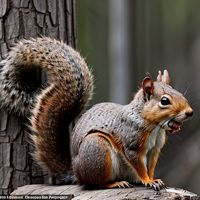
While squirrels are commonly recognized for their nut-gathering habits, recent scientific findings have revealed that these creatures can also exhibit carnivorous tendencies. A groundbreaking study has documented a species of squirrel engaging in the hunting, killing, and consumption of voles, a behavior previously unrecorded in these animals. The research, published in the Journal of Ethology, is a part of the Long-Term Behavioral Ecology of California Ground Squirrels Project at Briones Regional Park in Contra Costa County.
This project delves into how California ground squirrels, which are native to the grasslands of the state, modify their behavior in response to environmental shifts, particularly an increase in the local vole population. In certain areas of Northern California, vole infestations have been observed, and the research site has noted a significantly higher number of voles than usual over the past decade. Typically, California ground squirrels have been classified as herbivores or granivores, consuming mostly plants and seeds. However, these new findings provide the first evidence of the species actively preying on other live vertebrates, highlighting its adaptability to changes in the ecosystem.
"The research significantly alters our understanding of squirrels, one of the most familiar mammals globally," said Jennifer Smith, the lead study author and an associate professor of biology at the University of Wisconsin-Eau Claire. "In the face of human-induced challenges such as climate change and drought, these animals demonstrate resilience and the potential to adapt to a changing world." Squirrels play a crucial role in California's ecosystems, and understanding whether food discovery is a socially transmitted trait in these populations could offer valuable insights into how other species will adjust to shifting environments, Smith explained.
Smith and her team observed the squirrels' carnivorous behavior during a study period from June 10 to July 30. Throughout this time, the scientists used live traps to capture, mark, and release California ground squirrels on a biweekly basis. The research team collected comprehensive data on each squirrel, including its sex, reproductive status, and body mass, and labeled every animal with two identification tags and a unique fur mark using dye to ensure all the squirrels studied could be tracked throughout the observation period. Squirrels are particularly useful for studying animal resilience to environmental changes because they are active during the day and easy to trap, mark, and observe, Smith noted.
The researchers divided the squirrels into three groups and observed the animals' behavior on non-trapping days. The team recorded 74 interactions between the squirrels and voles, with 42% of the encounters involving squirrels—both male and female juveniles and adults—actively hunting and consuming the voles. "We already knew that California ground squirrels could live in a range of elevations and feed on a variety of plants, but what is most striking and incredible is the speed at which they shifted their behavior to this local surge in vole abundance," Smith said.
The study also uncovered previously undocumented social dynamics between squirrels and voles. Some interactions between the animals were positive, including foraging, greeting, and playing. Other behaviors were competitive, characterized by chasing, physical pushing, pouncing, and biting. "Voles have come to recognize the squirrels as predators," said John Koprowski, dean of the Haub School of Environment and Natural Resources at the University of Wyoming, who was not involved in the study. "There's likely some really neat interplay between the two species because being eaten is usually not a great way to continue passing on your genes."
The study's findings suggest that squirrels might be best classified as opportunistic omnivores based on their willingness to hunt and consume live prey, particularly when there is an abundant supply. Protein is a limited yet necessary resource for squirrels to thrive, and hunting voles likely provides them with a faster, more accessible nutrition boost than seeds, Koprowski explained. "It's a wonderful way for them to capitalize on a very abundant resource … to provide enough sustenance for many squirrels to use," he said. Although humans typically categorize animals by their eating habits, it's not uncommon for even the strictest carnivore to eat fruit occasionally, Koprowski added. This phenomenon, in which an animal capitalizes on a necessary resource when it's made available to them, is known as dietary plasticity, according to Koprowski. If an animal doesn't adapt to utilize the resource, it's likely another species will take advantage of it.
While this discovery may initially seem concerning to some, Koprowski said such a change in diet is quite normal for animals. Voles frequently experience surges in population growth and are considered pests, so having new predators such as California ground squirrels will help keep vole numbers under control, he said. The new findings may also help set the stage for future research on the adaptability of different squirrel species and other mammals in the face of environmental changes, according to Smith. "Animals can either adapt or go extinct in a human-impacted world," Smith said. "These animals are showing … us the incredible resilience of some species and by studying these processes we can offer meaningful insights for conservation."
By Laura Wilson/Dec 21, 2024

By Victoria Gonzalez/Dec 21, 2024

By James Moore/Dec 21, 2024

By Laura Wilson/Dec 21, 2024
By Lily Simpson/Dec 21, 2024

By Noah Bell/Dec 21, 2024

By Thomas Roberts/Dec 21, 2024

By Samuel Cooper/Dec 21, 2024
U6FGL)1L%5DUR%7B%7D~%24GQ7.png)
By Noah Bell/Dec 21, 2024
By Elizabeth Taylor/Dec 21, 2024

By Ryan Martin/Oct 15, 2024

By Eric Ward/Oct 15, 2024

By Joshua Howard/Oct 15, 2024

By Victoria Gonzalez/Oct 15, 2024

By Sophia Lewis/Oct 15, 2024

By Lily Simpson/Oct 15, 2024

By Ryan Martin/Oct 15, 2024

By Ryan Martin/Oct 15, 2024

By Jessica Lee/Oct 15, 2024